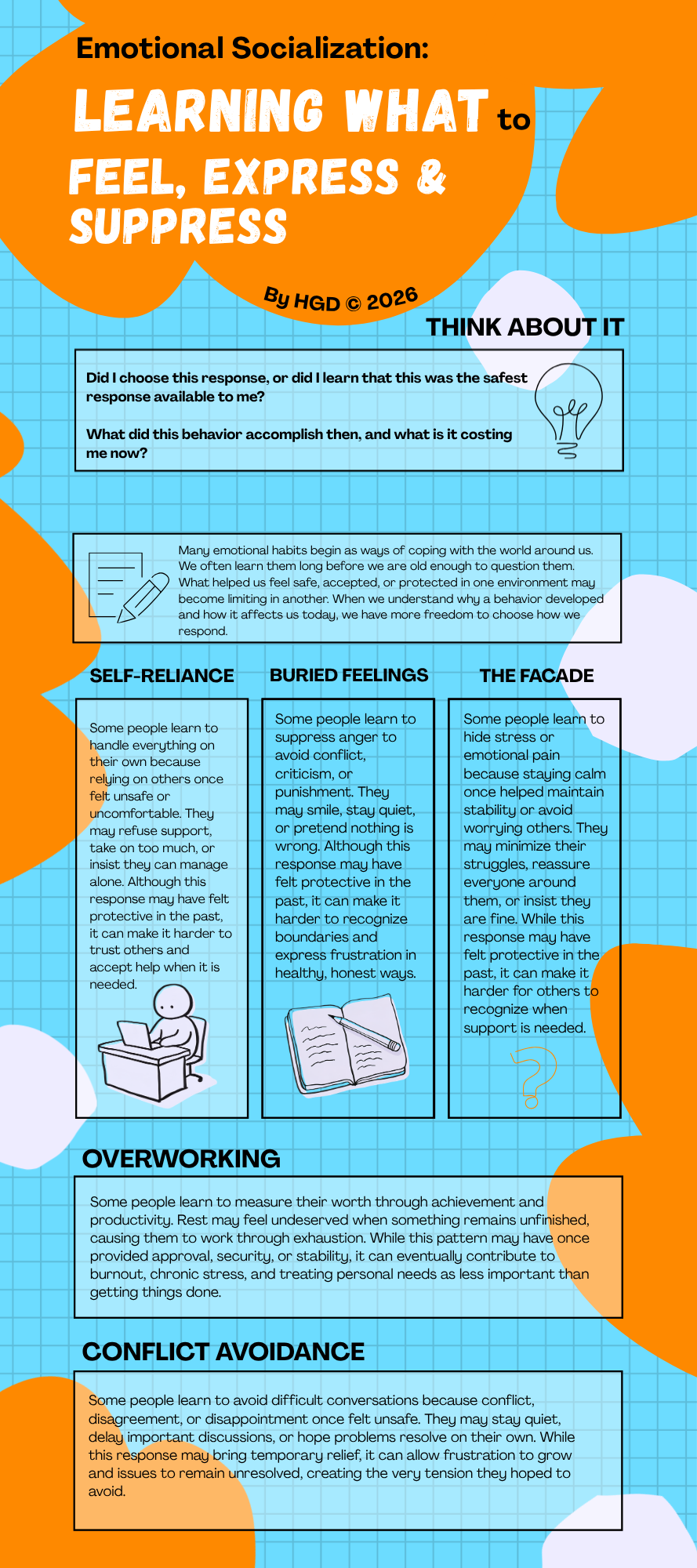

Hello everyone! Today, we’re going to have a unique approach with this topic. We’re focusing on emotional socialization and how it affects us throughout our adulthood. Of course, there are things here we already know and love (courtesy of those “self-help gurus” who talk about the same thing over and over. Well, here at HHH (Hari’s Helping Hands), we don’t focus on the surface-level stuff.
We dig deep.
We think deeply.
And we bridge the connection between what we already know and what we would like to know more of.
That’s it!
So, enjoy the ride, thank you again for your support, and enjoy some of the infographics I’ve included here. They’re free resources to use at anytime. I’ll also include some other goodies in the future (PDF downloads, printables, and mini audio lessons breaking down more core behavioral and emotional topics rolling into 2027).
***Disclaimer: Everything we discuss here and beyond is only for educational purposes only. I’m in no way a doctor or equipped to provide medical assistance. Please reach out to your provider if you’re needing help. I don’t mind listening, but I cannot medically help you.***
What Is Emotional Socialization?
Emotional socialization is the process through which people learn how emotions are understood, expressed, managed, and responded to within their social environments. We typically learn these lessons early, but they do not stop only at the childhood phase. Everything we see, touch, taste, hear, smell, and observe can influence what we learn about our emotions (and others as well).
Brief Takeaway: Emotional socialization is when we learn, emotionally, through relationships and environments. Keep in mind that people learn beyond emotional vocabulary. We also discover rules and emotional cues when things are or aren’t acceptable, who is allowed to express them, and what happens when they do.
Learning Emotional Rules
As you know, there are rules everywhere we go. What you may not have known is that there are emotional expectations as well—even if those expectations aren’t stated directly. For example, a child may learn that sadness receives comfort while anger is associated with punishment (and possibly isolation). Another child may learn that crying is discouraged but “good behavior” is heavily rewarded.
These examples are considered informal emotional rules. This is where we believe that we’re “not allowed to feel” certain things at this time or in this type of environment. Sometimes our kids may think that they’re only allowed to show and express certain feelings or responses to outward grievances because that’s what they’re taught to do.
Back In My Day Reflection: Growing up, I was told that children are supposed to be “seen and not heard” when we go shopping or when our parents are transacting business. As an adult, I still walk in my former shadow. If expressing something repeatedly creates conflict or a negative response, we may eventually stop expressing it. If staying quiet consistently receives approval, silence can become the preferred response.
Socialization Doesn’t Mean Something Went Wrong
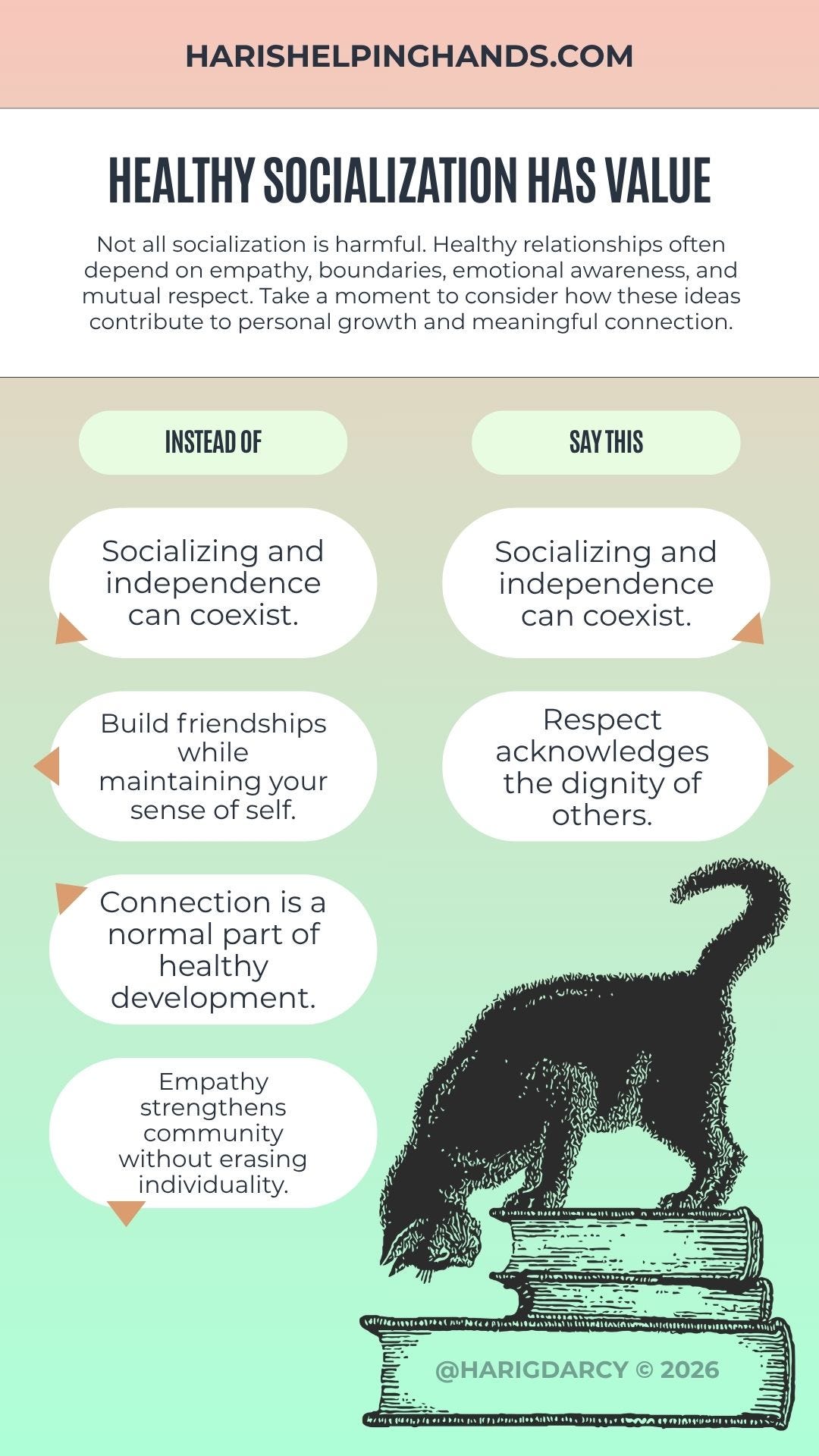
So it is not inherently harmful to socialize. In fact, it’s really healthy to make friends, build connections on and offline, and still have time to be yourself in private with yourself and those you trust. Learning emotional control, consideration, patience, cooperation, and appropriate expression can help people function effectively with others.
For example, understanding that anger doesn’t justify hurting someone is an important emotional lesson. Learning to pause before responding can improve communication. Of course, we’re not perfect, but that doesn’t mean we can’t do it. This is where emotional acknowledgement and empathy comes into play. Learning that other people have emotions and boundaries can support healthy relationships.
Adaptation (Code Switching) Can Become Rigidity
Some people learn to avoid difficult conversations because conflict, disagreement, or disappointment once felt overwhelming or unsafe. They may stay quiet when something bothers them, agree to things they do not want, or postpone conversations they know need to happen. Each time they avoid the conversation, they may feel temporary relief, but the problem remains. Over time, those unspoken frustrations can accumulate into resentment, especially when they repeatedly feel unheard while never expressing what they need. What began as avoiding conflict can eventually create the tension they were trying to prevent.
Brief Takeaway: Adaptation can help us function in different environments, but we should not lose ourselves trying to fit into them. We can understand where our behaviors came from while still choosing what we want to carry forward.

Emotional Conditioning
Emotional conditioning refers to learned associations between situations, emotional responses, and consequences. When a particular situation repeatedly leads to a particular outcome, people can begin anticipating that outcome automatically. Over time, the emotional response may happen before the person has consciously evaluated what is actually happening.
For example, someone who repeatedly experiences punishment after disagreeing with authority may eventually feel anxious when disagreeing, even in environments where disagreement is safe and expected. The reaction may have made sense in the original environment, but that does not mean it accurately reflects the environment they are in now.
Brief Takeaway: Conditioning helps explain why knowing something logically does not always change an emotional reaction immediately. A person may understand, “My manager is not angry with me,” while still feeling anxious because they learned to associate authority and disagreement with punishment. The reaction is learned, but learned does not mean accurate. Part of emotional awareness is recognizing when an old association is influencing a present situation.
Emotional Identity and the Outside-Inner Disconnect
Over time, repeated emotional expectations can become connected to identity. People may begin describing themselves as “easygoing,” “strong,” “independent,” “low-maintenance,” “sensitive,” “difficult,” or “emotional.” These labels can reflect genuine personality traits, but they can also reinforce behaviors that were repeatedly rewarded or expected. Being independent, emotional, or agreeable is not automatically unhealthy. The concern is whether the label still allows room to respond differently when circumstances require it.
When an identity becomes tied to how we believe we are supposed to behave, it can influence what we allow ourselves to express. Someone who sees themselves as “easygoing” may ignore frustration to avoid seeming difficult. Someone who identifies as “strong” may struggle to admit when they need help. Over time, this can create a disconnect between what someone feels internally and what they show externally. They may appear emotionally stable while feeling overwhelmed, agree to something while wanting to refuse, or experience anger without recognizing that a boundary has been crossed.
Repeatedly overriding these internal signals can make them harder to recognize. The issue is not that the person has lost their emotions, but that they may have become so practiced at dismissing them that identifying their needs, preferences, discomfort, and emotional limits becomes more difficult.
Emotional Socialization at Work
The patterns we learn through emotional socialization do not disappear when we become adults. As discussed earlier, conditioning can shape our automatic reactions, while emotional identity can influence how we believe we should behave. The workplace becomes another setting where these patterns can be reinforced, challenged, or changed.
Workplaces teach emotional expectations in many ways, including policies, leadership behavior, rewards, consequences, informal norms, and organizational culture. Employees may learn that speaking up is welcomed, mistakes can be discussed openly, and questions are encouraged. In other workplaces, they may learn that constant availability, emotional restraint, unquestioned agreement, or avoiding difficult conversations receives greater approval.
Past experiences can also shape how people interpret workplace interactions. A neutral request may register as criticism, feedback may feel like rejection, and a supervisor's disagreement may seem threatening. Even asking questions can feel like admitting incompetence. Sometimes these reactions reflect earlier emotional learning. Other times, the workplace itself may reinforce them through its culture, expectations, and responses.
Summary
Emotional socialization’s all about learning what emotions mean, how to share them, and how to handle others’ emotional qualities. These lessons often begin in childhood, but they continue throughout adulthood through our relationships, culture, workplaces, and everyday experiences. Throughout life, we can form emotional habits, discover methods to manage conflict, and even shape parts of our identity based on the behaviors we were taught. These lessons shouldn't be considered bad by default. They often help us with communication, collaboration, emotional management, and developing healthy relationships.
The problem can start when an old emotional pattern no longer fits our current life. Emotional conditioning can cause certain situations to trigger strong reactions before we have time to think about what is happening. We may also have trouble asking for help, saying no, speaking up, or recognizing what we actually need. Understanding emotional socialization, emotional conditioning, emotional awareness, and emotional patterns can help us look at where these behaviors came from and decide what we still want to carry with us.