

Many people misunderstand what self-forgiveness actually requires. Some assume forgiving themselves means minimizing what happened, pretending the pain no longer exists, or deciding to “move on.” In reality, self-forgiveness begins by acknowledging that challenging or hard experiences, poor decisions, and painful consequences are real, while recognizing that continuing to punish oneself rarely produces healing. The goal is not to erase the past, but to develop a healthier relationship with it.
Similar Article to Check Out!

This is why self forgiveness practices can feel helpful without ever resolving anything. They soothe the story without correcting the premise underneath it. A person can forgive themselves a hundred times for the same choice and still carry the weight, because forgiveness assumes guilt was legitimate in the first place. What actually dissolves the weight is not forgiveness. It is recognizing there was nothing to forgive because there was never a second path. —Nancy Thames, 2026 / Source: Substack
Psychologically speaking, people tend to assess their prior deeds through the lens of present knowledge, disregarding the knowledge they had then. This leads to an unfair standard called hindsight bias. Hindsight bias refers to the tendency to see past decisions as obvious once the result is known (Roese & Vohs, 2012). When people constantly re-examine past errors with this perspective, guilt transforms into persistent self-blame. Rather than gaining insight, they get stuck reliving the event, convinced they ought to have been a different person than they were at that time.
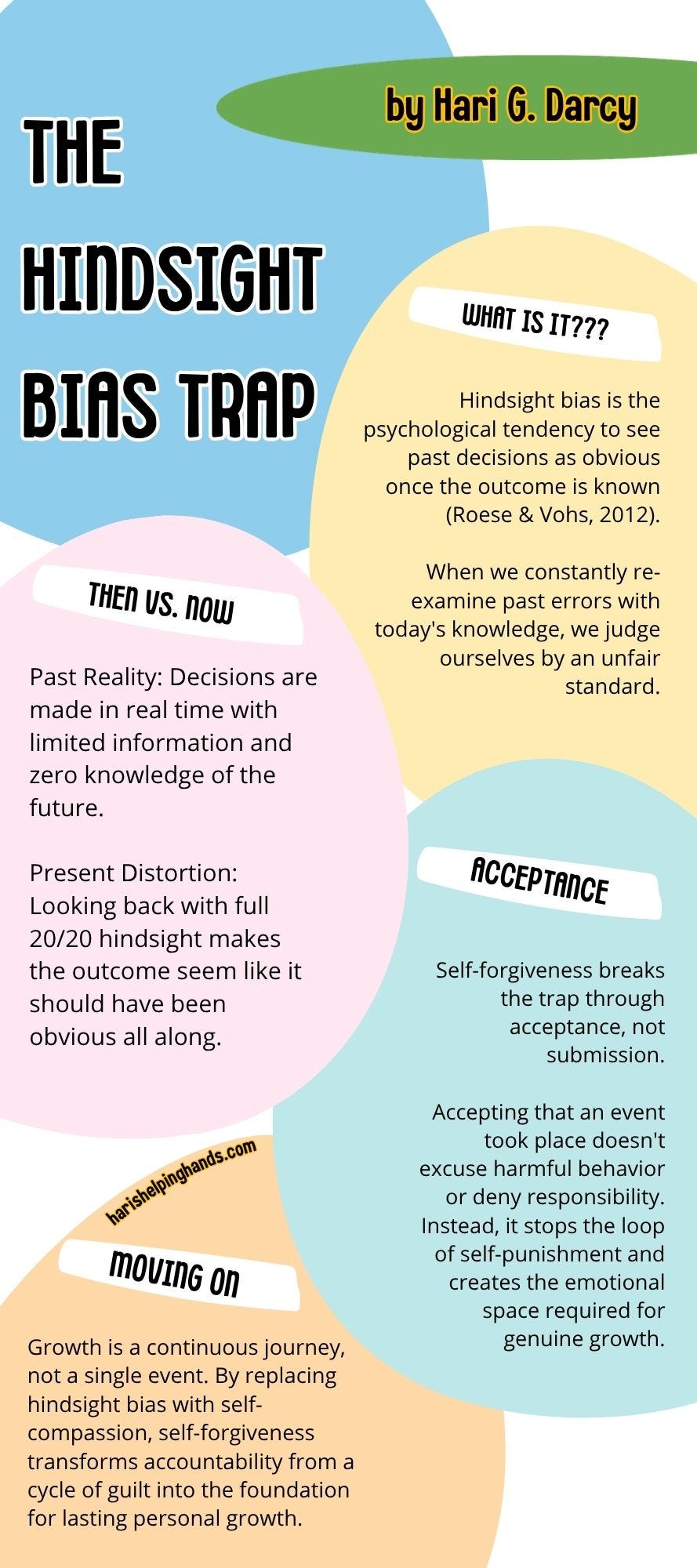
Self-forgiveness breaks that cycle through acceptance, not submission. The essence of acceptance is recognizing that something took place. This does not mean that harmful behavior is excused, consequences are ignored, or responsibility is denied. Instead, it allows ample emotional room for growth to start. From there, accountability becomes more productive because it is driven by the desire to improve instead of the need to continually relive personal failure.
A simple mindset like “It happened, and I will be better” can help change this pattern. Unlike statements that dismiss emotional pain, this affirmation neither denies reality nor demands perfection. Instead, it acknowledges the past while placing greater value on future choices. It transforms the conversation from one centered on punishment to one centered on progress. By doing this, it helps people understand growth as a journey, not a single event.
Research in psychology consistently shows that self-compassion and self-forgiveness support resilience, emotional regulation, and long-term behavioral change. People who allow themselves to learn from mistakes instead of defining themselves by them are often better equipped to develop healthier habits, stronger relationships, and greater emotional well-being. Self-forgiveness does not eliminate responsibility; it creates the emotional conditions necessary to take responsibility in a constructive way.
In the end, self-forgiveness isn’t about telling yourself to move on. The idea is to accept that history cannot be altered, while realizing that the future is still in the making. Everyone has regrets, but the path to healing starts not with dwelling on past selves, but with envisioning future ones. Self-forgiveness is not the end of accountability—it is the beginning of transformation.
References:
1. Roese, N. J., & Vohs, K. D. (2012). Hindsight Bias. Perspectives on psychological science : a journal of the Association for Psychological Science, 7(5), 411–426. https://doi.org/10.1177/1745691612454303
The hindsight bias part really landed for me. We’re very good at judging our past selves with information they didn’t have yet. I also appreciate that you’ve kept accountability in the conversation. Learning from something and sentencing yourself to think about it forever are two very different things. ❤️