


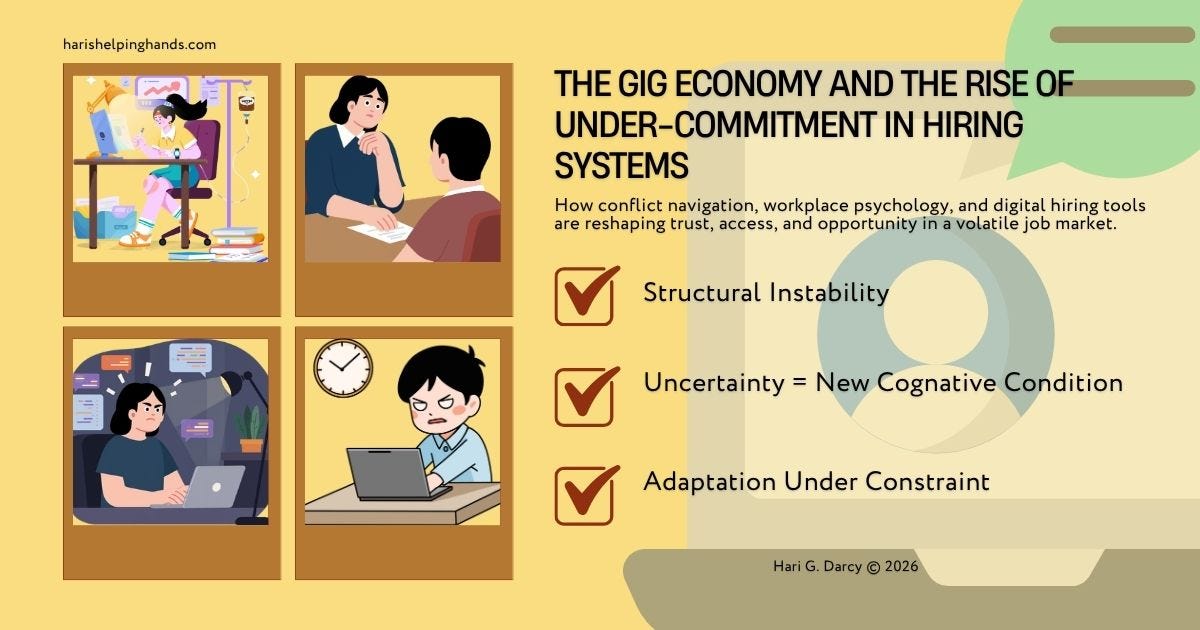
When I look at today’s job market, I see instability in hiring relationships shaped by algorithmic hiring systems, gig-based labor structures, and opaque evaluation and onboarding processes, where both employers and job seekers continuously recalibrate their behavior in response to uncertainty rather than sustained trust. This produces a measurable pattern of defensive coping, reduced institutional trust, and escalating job-hopping or disengagement that is not incidental, but structurally embedded in how modern labor systems operate.
Structural Instability as a Defining Feature of Contemporary Labor
The modern labor market isn’t just flexible — it’s unstable by design. What many companies call “flexibility” often ends up shifting more risk onto workers and employers at the same time. Digital platforms, automated screening tools, and short-term hiring cycles make it easier to move people in and out of roles, but they also make it harder for anyone to feel secure. These systems don’t remove uncertainty. They organize it.
In gig-heavy and contract-based environments, long-term commitment is no longer the default. Instead, both employers and job seekers operate inside constantly changing expectations. Commitment becomes something that can be adjusted, paused, or withdrawn, depending on the moment. The result is a workplace culture where instability isn’t a temporary problem — it’s the normal operating condition.
Similar Article Based on This Section: The Transition Gap Between Traditional and Non-Traditional Work Since the COVID-19 Pandemic—Hari G. Darcy
Many workers were told to “pivot online,” but online work requires digital skills that most traditional jobs never demanded. People whose careers were built on physical labor, routine tasks, or hands‑on work often struggle because these strengths don’t translate easily into digital income. Research shows that when someone’s work identity is tied to physical skill, shifting to computer‑based work can feel confusing, overwhelming, or like losing a part of themselves.
When Uncertainty Becomes a Cognitive Condition

Over the past six months, I’ve experienced how sustained job searching reshapes cognition itself. Job hunting no longer feels like evaluation—it feels like endurance. The shift is not emotional alone. It is cognitive exhaustion produced by repeated exposure to incomplete, inconsistent, or non-transparent information.
This aligns with research on job insecurity, which shows that unstable work conditions produce not only emotional strain but also systematic changes in how individuals allocate cognitive resources. Under conditions of uncertainty, individuals shift into defensive coping modes that prioritize preservation over exploration, narrowing attention and reducing engagement with complex decision-making demands (Lee et al., 2022). In practical terms, uncertainty does not just create stress—it reorganizes how people think under pressure.
A similar cognitive strain emerges during the application process itself. Many job seekers are required to respond to incomplete or ambiguous prompts without visibility into how decisions are made. This is not a minor inconvenience; it is a structural feature of algorithmically mediated hiring systems.
Research on AI-based hiring assessments shows that these systems often reduce applicants to standardized, non-negotiable representations of their attributes, limiting their ability to clarify, contextualize, or narrate their own experience within the evaluation process (Aizenberg et al., 2023). In effect, the applicant is evaluated through a system that does not allow reciprocal interpretation. This produces a specific kind of cognitive load: effort spent trying to interpret an evaluation process that remains structurally opaque.
This is why uncertainty becomes persistent rather than episodic. It is embedded in the system itself.
Adaptation Under Constraint, Not Preference

During this period, I was still building my newsletter, managing my health, and adjusting to post‑pregnancy life. None of these things existed in separate boxes. They were all happening at the same time, pulling from the same mental energy. When you’re juggling that many responsibilities, decision‑making stops being about choosing the “best” option. It becomes about choosing the option that won’t break the rest of your life in the process.
So when I was approved for two roles — a contract job with flexible hours and a full‑time remote job with lower pay than I expected — the decision wasn’t about what I preferred. It was about what was stable enough to support everything else I was carrying. I wasn’t comparing dream jobs. I was comparing what was workable. The deciding factors weren’t ideal conditions. They were practical ones: equipment provided, reliable scheduling, and the ability to manage the workload without sacrificing my health or my family.
This is what adaptation looks like in unstable labor systems. People don’t adjust because they lack ambition or standards. They adjust because the system forces them to make decisions within tight constraints. It’s not resignation. It’s recalibration — choosing what keeps you steady when the surrounding environment isn’t.
When Effort No Longer Guarantees Stability

As I was adjusting my own decisions around work, I started noticing similar patterns in the people around me. It became clear that I wasn’t the only one recalibrating my effort based on what felt sustainable rather than ideal. The same logic shows up in workplaces everywhere, even in roles that look stable from the outside.
A friend of mine works at a small pizza business. He has been there for years, rarely misses shifts, and often steps in when the team is short‑staffed. His consistency is not the issue. The problem is that his effort has never been matched with clear advancement or reliable recognition. At the same time, he has a physical limitation that makes heavy lifting and long stretches of strain difficult. Those two realities collide: high effort on his part, low structural support on theirs.
What develops in situations like this isn’t disengagement. It’s recalibration. When someone realizes that extra effort doesn’t reliably lead to better outcomes, they start adjusting their energy to what they can maintain without harming themselves. They work enough to stay employed, but not enough to risk their health or invest in expectations that may never materialize.
This pattern is widely recognized in research on job insecurity. When people sense instability in future outcomes, they naturally reduce discretionary effort and shift toward coping strategies that protect their limited physical and emotional resources. From the outside, it can look like reduced commitment. In reality, it’s a rational response to inconsistent reward structures — not a decline in work ethic, but a shift toward self‑preservation.

Algorithmic Gatekeeping and the Disappearance of Transparency

As I continued navigating different contract opportunities, I started noticing another pattern that didn’t come from people — it came from the systems themselves. Many gig‑based platforms use automated screening tools to decide who moves forward and who doesn’t, and the results can feel unpredictable even when the applicants are qualified.
In one situation, an application was permanently blocked because a required section didn’t register correctly. There was no option to fix the mistake, no way to reapply, and no human contact to clarify what happened. The system simply closed the door. In another case, two applicants with similar experience went through the same screening process, yet only one was approved. Neither received an explanation, and there was no clear reason for the difference in outcome.
These experiences aren’t rare. They’re part of how algorithmic hiring works. Automated systems often reduce people to fixed categories or scores, leaving no room to explain context, growth, or personal circumstances. The system evaluates you, but you can’t evaluate it. You can’t ask questions, clarify misunderstandings, or provide additional information. You’re judged by a process that doesn’t allow conversation.
This matters because under‑commitment doesn’t start after someone gets hired. It starts the moment applicants realize they’re interacting with a system that doesn’t respond to them. When people feel invisible or misread by automated tools, they naturally adjust their expectations and their effort. They apply more broadly, invest less emotionally, and treat the process as something to navigate rather than something to trust.
The issue isn’t that technology exists. The issue is that the technology is opaque. When the rules aren’t visible, and the outcomes aren’t explained, people learn to protect themselves. And that protective mindset follows them into every stage of the labor market.
System‑Driven Conflict and Mutual Pullback

As I moved through different hiring systems, I realized that modern labor conflict doesn’t look like disagreement or negotiation anymore. It shows up as silence, automated decisions, and long stretches of waiting with no explanation. The system communicates by withholding information, and people learn to read that silence as part of the process.
When job seekers face this kind of uncertainty, they adjust. They apply to more roles, invest less emotional energy, and treat the process like a numbers game instead of a relationship. Employers adjust too. They rely more on automation, reduce direct communication, and prioritize speed over clarity. Both sides are responding to risk, but neither side is actually talking to the other. The distance becomes the strategy.
This pattern becomes even stronger in gig and contract‑based environments. Workers depend on platforms for income, while employers depend on them for flexibility. Responsibility shifts from people to systems, and the systems themselves become the gatekeepers. Most people don’t realize that many platforms use automated “risk scores” to decide who gets opportunities, or that some screening tools permanently block applicants after a single failed attempt, even when the issue is technical rather than skill‑based.
As uncertainty continues, both sides pull back in predictable ways. Workers conserve their energy because they don’t know what will pay off. Employers reduce long‑term investment because they don’t know who will stay. Over time, these adjustments reinforce each other. Under‑commitment stops being a personal choice and becomes a structural outcome — a product of systems that sort people without conversation and evaluate them without context.
This is the environment people are navigating. Not a lack of effort. Not a lack of ambition. A system that teaches both sides to protect themselves first.
Conclusion: Structural Response, Not Individual Failure

Under-commitment in today’s labor market should not be interpreted as a moral or motivational failure. It is a structural response to sustained uncertainty embedded in hiring systems that are simultaneously automated, fragmented, and opaque.
What is often framed as flexibility is, in practice, a redistribution of risk without corresponding redistribution of clarity. A stable system would require transparent hiring timelines, consistent evaluation criteria, meaningful human involvement in screening processes, and clearly defined expectations around flexibility and advancement.
The goal is not to eliminate gig work or contractual labor structures. The goal is to build systems where flexibility does not depend on uncertainty, and where trust is not replaced by automation.
Until then, under-commitment will continue to function exactly as it is designed to function: as an adaptive response to a system that no longer guarantees stability from either side of the employment relationship.
Citations
Aizenberg, E., Dennis, M. J., & Van Den Hoven, J. (2023). Examining the assumptions of AI hiring assessments and their impact on job seekers’ autonomy over self-representation. AI & Society, 40(2), 919–927. https://doi.org/10.1007/s00146-023-01783-1
Lee, S., Hur, W., & Shin, Y. (2022). Struggling to stay engaged during adversity: A daily investigation of frontline service employees’ job insecurity and the moderating role of ethical leader behavior. Journal of Business Ethics, 184(1), 281–295. https://doi.org/10.1007/s10551-022-05140-y