

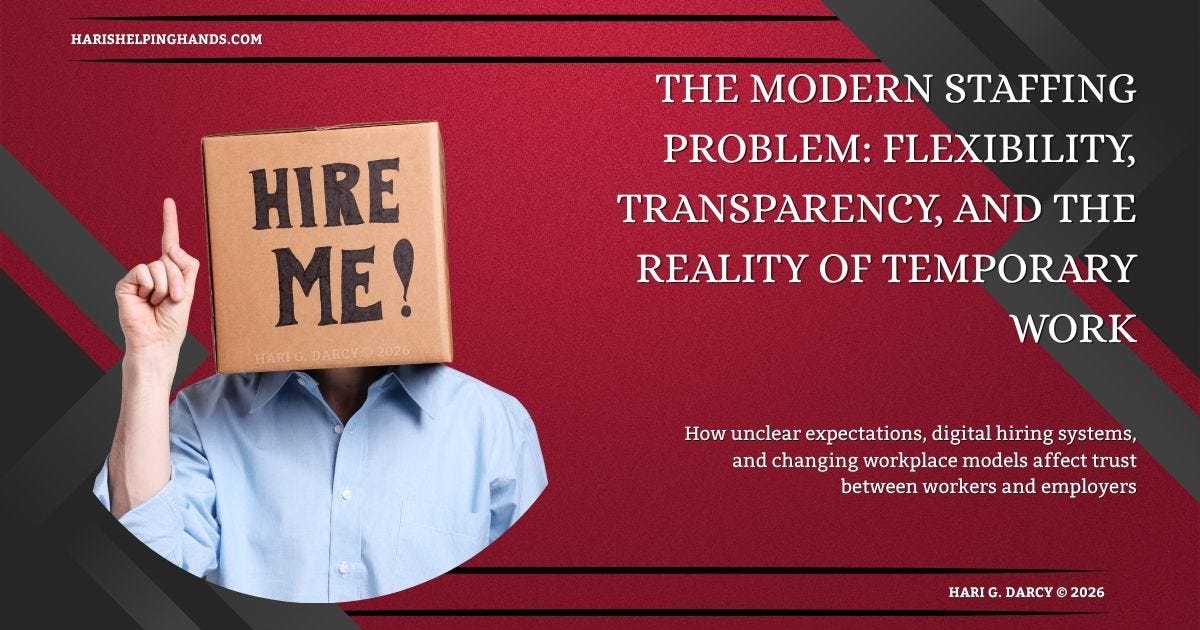
Understanding the Problem
One of the growing challenges in today’s job market is not only finding work, but understanding what that work actually requires before accepting it. Across job boards, staffing platforms, and company websites, terms such as “flexible,” “remote,” “contract,” and “temporary” are commonly used to describe employment opportunities. While these terms can create a sense of accessibility and adaptability, their meaning often changes depending on the employer, the industry, and the worker’s expectations.
For job seekers, this can create a difficult gap between what is presented and what is experienced. A position may appear to offer the stability, schedule, or flexibility someone needs, but the actual expectations may become clearer only after the application process has already begun. When the details of a role are not communicated effectively, workers may find themselves trying to adjust to expectations they did not fully understand at the beginning.
This is where uncertainty becomes a larger workplace issue. The problem is not simply that misunderstandings happen. It is that unclear communication can influence how people make decisions about their careers, finances, and personal responsibilities.
The Psychological Impact of Uncertainty

Employment decisions are often connected to more than a paycheck. Many people are searching for work while balancing family responsibilities, healthcare needs, education, financial pressure, or the desire for long-term stability. Because employment affects so many areas of life, uncertainty during the hiring process can carry an emotional weight beyond the application itself.
Repeatedly applying for jobs, completing interviews, waiting for responses, or trying to understand unclear expectations can create stress and emotional fatigue. Over time, this can affect a person’s confidence in the hiring process and their sense of control over their own progress.
For temporary workers and those navigating less traditional employment arrangements, these concerns can become even more complicated. Temporary agency workers often have to actively manage their careers while navigating unstable employment conditions, making stability and long-term career planning more difficult (Retkowsky et al., 2023).
This does not mean workers lack patience or dedication. Instead, it highlights how prolonged uncertainty can influence decision-making. When people experience repeated barriers, they may begin prioritizing immediate stability over long-term career alignment. A person may accept an opportunity not because it perfectly fits their goals, but because they need something reliable in that moment.

The Problem With Undefined Flexibility

One of the most common examples of unclear expectations is the use of the word “flexibility.” Flexibility is often presented as a benefit, but it does not always have a consistent definition.
In one workplace, flexibility may mean adjusting a schedule when needed. In another, it may mean working remotely while still being available during specific hours. In another environment, it may mean that schedules change based on staffing needs or business demands.
None of these approaches are automatically wrong. Different industries have different operational requirements. The concern begins when flexibility is used without explaining what it means in practice.
When expectations are unclear, workers and employers may enter the same agreement with different assumptions. A worker may believe flexibility means they have greater control over their schedule, while an employer may mean that the worker has flexibility within certain business limitations.
This type of misunderstanding is not always caused by poor intentions. It often develops because communication happens too quickly, information is incomplete, or systems prioritize speed over clarity.
Technology and the Changing Hiring Process

Technology has changed how people search for and apply to jobs. Digital hiring platforms have made opportunities easier to access and have allowed companies to connect with larger groups of applicants.
However, faster processes do not always create clearer processes.
Some job postings remain active after a position has been filled. Some opportunities appear across multiple platforms without consistent updates. Others rely heavily on automated systems that limit early opportunities for applicants to ask questions or receive explanations.
For job seekers, this can create uncertainty about what opportunities are current, what employers are actively hiring, and what the expectations truly are.
Technology is not the problem by itself. Digital tools can improve accessibility, reduce delays, and help organizations manage large amounts of information. The challenge is making sure these systems continue to support communication rather than create more distance between people.
The Role of AI in Modern Hiring Systems

Artificial intelligence and automated tools are becoming more common in recruitment. These tools can assist with sorting applications, scheduling interviews, and organizing information. When used appropriately, they can help reduce repetitive tasks and allow hiring teams to focus their attention where it is needed.
However, hiring is not only a process of matching information. It is also a process of understanding people.
When applicants interact primarily with automated systems, they may have fewer opportunities to explain their experiences, goals, or circumstances in their own words. Research examining AI hiring assessments raises concerns about how automated evaluations may affect job seekers’ ability to represent themselves and maintain control over how their qualifications are interpreted (Aizenberg et al., 2023).
Additionally, perceptions of fairness in algorithmic recruiting are influenced by whether applicants believe the process is transparent and understandable. Even when organizations use consistent systems, applicants may still question fairness if they do not understand how decisions are being made (Ochmann et al., 2024).
Technology can support hiring, but human judgment remains important because people are more than the information a system can measure.
Building Better Communication Between Workers and Employers

Hiring challenges are often viewed as a conflict between workers and employers, but the reality is more complex. Both sides are trying to navigate a changing workplace environment.
Employers have a responsibility to provide accurate job descriptions, communicate expectations clearly, and create systems that allow workers to understand the role they are accepting.
Workers also have a responsibility to ask questions, evaluate opportunities carefully, and communicate their own needs when possible.
However, meaningful communication requires both sides to have access to accurate information.
A job seeker cannot make a fully informed decision if important details are missing. An employer cannot build a successful working relationship if expectations are unclear from the beginning.
What a More Transparent System Could Look Like

Improving staffing systems does not require removing technology or eliminating flexible work. Instead, it requires creating stronger communication practices.
Some improvements may include keeping job postings updated, clearly defining what flexibility means within each role, explaining scheduling expectations before hiring decisions are made, and maintaining human involvement throughout the process.
Short-term agreements, such as structured 30, 60, or 90-day periods, may also help both workers and employers evaluate whether a position is a good fit. Clear evaluation points allow expectations to be reviewed rather than assumed.
The goal is not to remove every challenge from employment. Work will always involve adjustment, growth, and problem-solving. The goal is to reduce unnecessary confusion that prevents people from making informed decisions.
Closing Thoughts

The modern job market continues to change as technology, staffing models, and workplace expectations evolve. However, one principle remains consistent: people make better decisions when they understand what they are agreeing to.
Uncertainty affects how people think, respond, and plan for the future. It can influence trust, motivation, and emotional well-being throughout the employment process.
A clearer hiring system does not only benefit organizations. It helps workers understand opportunities more accurately and approach employment decisions with greater confidence.
In a workplace environment shaped by rapid technological change, transparency is not simply a preference. It is the foundation for healthier working relationships.
Citations
Retkowsky, J., Nijs, S., Akkermans, J., Khapova, S., & Jansen, P. (2023). Seeking stability in unstable employment: An exploratory study of temporary agency workers’ career self-management. Journal of Vocational Behavior, 143, 103877. https://doi.org/10.1016/j.jvb.2023.103877
Ochmann, J., Michels, L., Tiefenbeck, V., Maier, C., & Laumer, S. (2024). Perceived algorithmic fairness: An empirical study of transparency and anthropomorphism in algorithmic recruiting. Information Systems Journal, 34(2), 384–414. https://doi.org/10.1111/isj.12482
Aizenberg, E., Dennis, M. J., & Van Den Hoven, J. (2023). Examining the assumptions of AI hiring assessments and their impact on job seekers’ autonomy over self-representation. AI & Society, 40(2), 919–927. https://doi.org/10.1007/s00146-023-01783-1