

Think about the last time you learned something new. Chances are, someone showed you how to do it before you ever tried it yourself. Whether it was tying your shoes, driving a car, solving a problem at work, or learning how to communicate with others, observation was probably your first teacher. Psychologist Albert Bandura called this Social Learning Theory, which explains that people often learn by watching others, practicing what they observe, and deciding whether those behaviors are worth repeating.
One of the first skills I learned this way was braiding hair. My older sister never sat me down for a formal lesson. Instead, she handed me a mannequin head and encouraged me to figure it out. At first, I was intimidated, but I paid close attention to how her hands moved whenever she braided my hair. Over time, I practiced those same movements, made plenty of mistakes, and eventually developed my own technique. Looking back, she wasn’t just teaching me how to braid hair—she was teaching me independence and reminding me that mistakes are often part of the learning process.
Social learning is about much more than copying another person’s actions. Bandura believed successful learning involves several steps: paying attention to the behavior, remembering what was observed, practicing it ourselves, and having enough motivation to keep improving. We don’t imitate everything we see. Instead, we naturally choose what aligns with our goals, values, and experiences.
I have seen this play out in other parts of my life as well. When playing Mobile Legends, I often watched someone else’s strategy before trying it myself. While their approach worked well for them, I eventually realized it didn’t always fit my own play style. I learned that observation gives us a starting point, but growth happens when we adapt what we’ve learned instead of becoming a copy of someone else.
One of the people who influenced my own learning journey is Kyle. Through countless conversations, he introduced me to different areas of psychology and encouraged me to think more deeply about emotional awareness. We learned from one another by asking questions, sharing personal experiences, and remaining open to different perspectives. That mutual curiosity strengthened my interest in psychology and reminded me that some of the best teachers are simply people willing to grow alongside us.
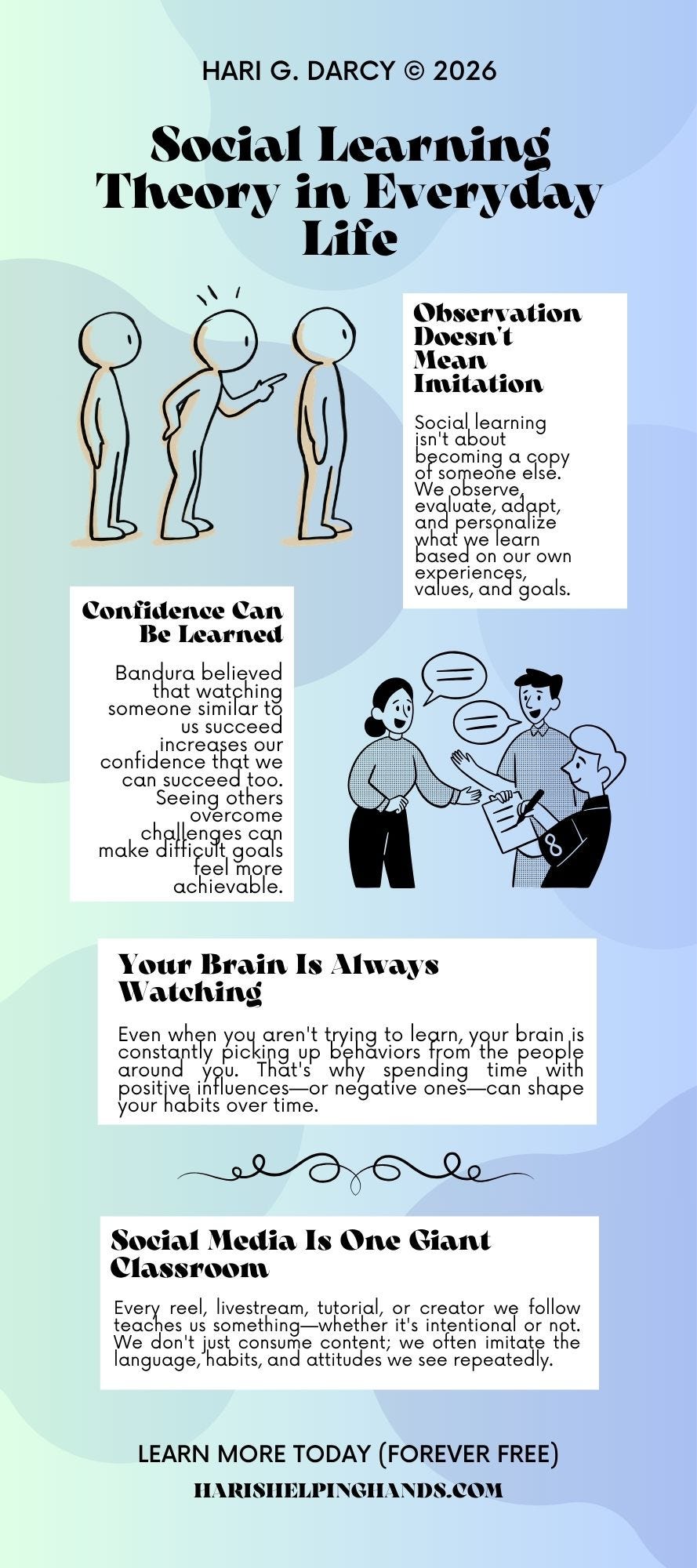
If I could teach one life skill through observation, it would be emotional intelligence. Rather than telling someone how they should feel, I would walk beside them as they learned to recognize, understand, and work through their emotions. People rarely grow because someone lectures them. They grow because someone creates a safe environment where they can observe healthy behaviors, practice them, and gradually make those habits their own.
Social learning reminds us that we are always influencing one another, whether we realize it or not. Every conversation, every action, and every response has the potential to teach someone something. The question is not only who we are learning from, but also what we are teaching through the example we set. After all, observation may introduce a new skill, but it is our choices that transform it into something uniquely our own.