

Have you ever walked into a room and forgotten why you were there? Maybe you opened a document and suddenly forgot what you wanted to write, or someone asked you a question and your mind went completely blank. Many people assume these moments mean they have a bad memory, but memory is much more complex than simply remembering or forgetting. Sometimes the issue is not that the information was never learned, but that our brain did not have the right conditions to process and retrieve it.
Psychologists describe memory through three stages: encoding, storage, and retrieval. Encoding is when our brain receives information and gives it meaning, storage is when that information is maintained over time, and retrieval is when we access it later. These stages work together, but they also depend on one another because information that is not properly encoded becomes harder to store and recall. This is why quality attention plays such an important role in learning.
I have experienced this while training for different call center positions where employees are expected to learn multiple systems, policies, procedures, and legal requirements within a short amount of time. One of the most important things I focus on is remembering customer disclosures, such as informing customers that calls are recorded and monitored for quality assurance purposes. However, during role-play activities, I have experienced moments where I knew the information but failed to retrieve it because my attention was focused on solving a more complicated customer situation. The information was not gone; my brain was simply prioritizing another task in that moment.
This experience has taught me that hands-on learning is one of the strongest ways I remember information. Reading procedures and reviewing training materials helps introduce concepts, but practicing those concepts is what allows them to become natural. Similar to learning how to type, drive, or play an instrument, repetition strengthens our ability to perform tasks without having to consciously think about every step. What starts as something we have to carefully process eventually becomes something we can confidently execute.
Stress and distractions can also affect how well we learn and remember information. When our minds are overwhelmed, we may hear information without fully absorbing it or read instructions without truly understanding them. Modern life constantly asks us to switch between responsibilities, notifications, conversations, and tasks, which can make it harder to give anything our full mental energy. The challenge is not always that people have poor memories; sometimes their brains are simply overloaded.
Quality attention is not about forcing ourselves to focus on everything at once. It is about understanding what deserves our mental energy and creating enough space for our brains to process information. I think of it like a music playlist: we may have thousands of songs saved, but we usually return to the ones we know best because we understand the lyrics, rhythm, and story behind them. Memory works similarly because the information we repeatedly engage with becomes easier to recognize and retrieve.
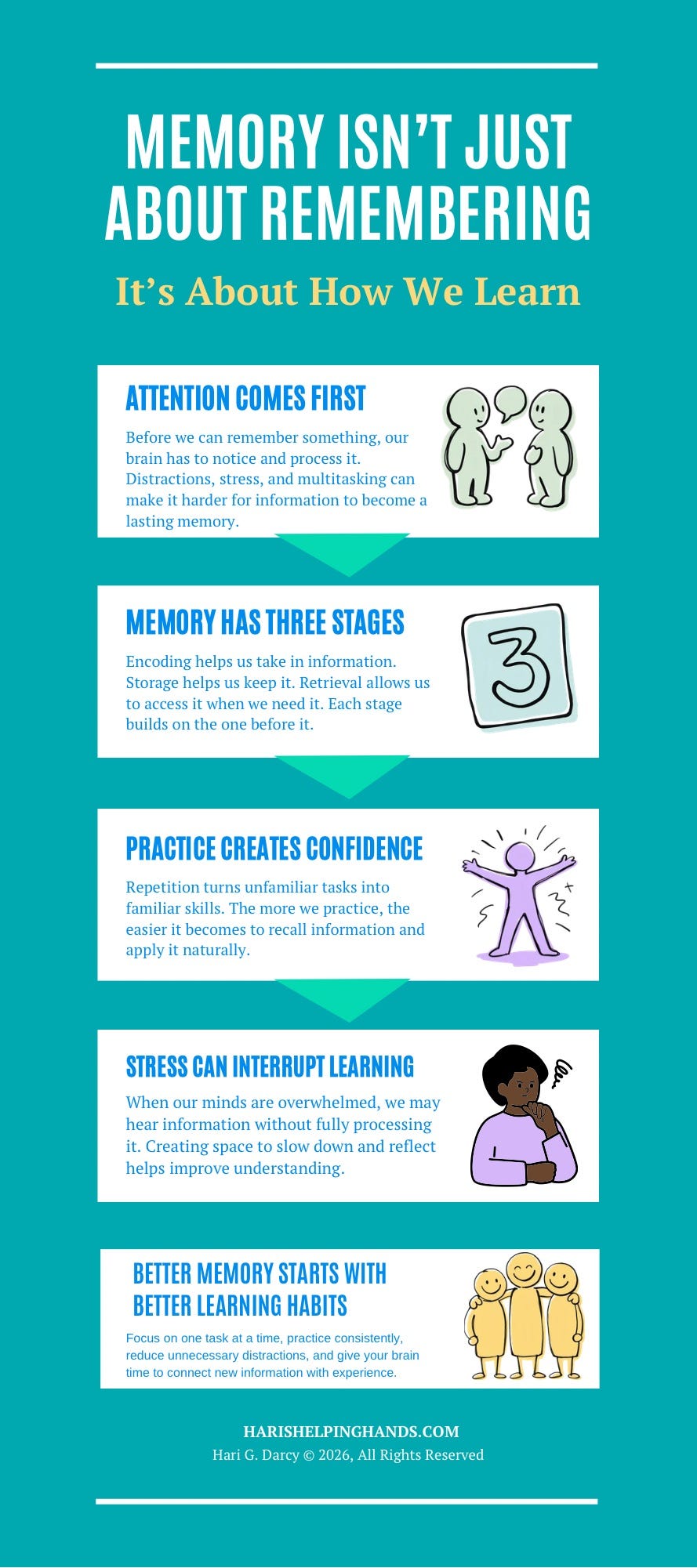
Understanding memory is not about becoming someone who never forgets anything. Forgetting is part of being human, and our memories are influenced by attention, emotions, experiences, and repetition. The goal is not perfection but awareness of how our brains learn and what conditions help us succeed. Sometimes our memory is not failing us; sometimes our brain simply needs more time, practice, and meaningful connection before information becomes something we can confidently retrieve.